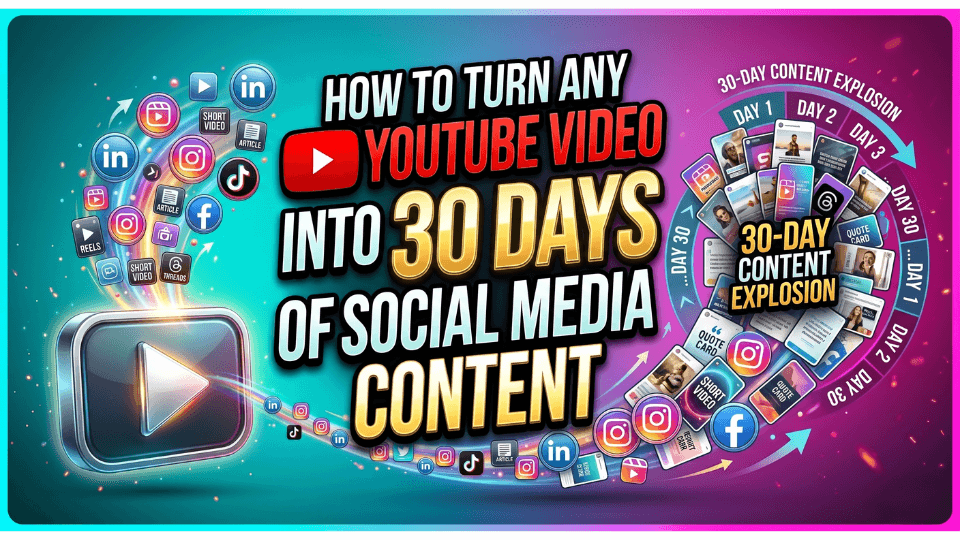
The math on YouTube content has never made sense.
You spend four hours filming, editing, and publishing a video. It goes live. It gets views. Then it sits in your video library while you scramble to create fresh content for Instagram, LinkedIn, Threads, and X.
Meanwhile, that video contains 30 distinct ideas, frameworks, and insights that could fuel your entire social media calendar for a month. The content is already there. You already did the work. But extracting it manually takes longer than creating the video in the first place.
This gap between what you have and what you could create is where most content strategies break down.
Why Manual Repurposing Fails at Scale
The standard advice is to watch your video, pull quotes, screenshot key moments, and manually adapt each insight for different platforms.
That works once. Maybe twice. Then reality hits.
Instagram captions need hooks and storytelling. LinkedIn posts require professional framing and data. X threads demand punchy, quotable segments. Threads rewards personality and rapid-fire posting.
Each platform has different character limits, formatting rules, and audience expectations. A LinkedIn post that performs well reads completely differently from an Instagram caption or an X thread.
The core problem is not effort—it is that each platform has distinct formatting rules, audience expectations, and engagement patterns. MindStudio
When you try to manually adapt one video into content for four platforms, you face a choice: spend six hours reformatting the same material, or copy-paste the same generic text everywhere and watch engagement tank.
Most teams choose a third option: they abandon the repurposing effort entirely and let the video content die on YouTube.
What YouTube Videos Actually Contain
A 20-minute YouTube video is not one piece of content. It is a content treasury.
Every video includes multiple layers that can be extracted and redistributed:
Core narrative structure: The main argument or story that can become a LinkedIn article or blog post.
Quotable segments: 10-15 second clips that work as standalone social videos or quote graphics.
Data points and statistics: Individual facts that become single-post hooks.
Frameworks and methodologies: Step-by-step processes that translate into carousel posts or threads.
Tactical advice: Specific tips that work as quick-hit posts across any platform.
Visual moments: B-roll, demonstrations, or reactions that can be clipped and shared independently.
The content density is already there. The challenge is extraction without burning your entire week on reformatting.
How Platform-Native Adaptation Actually Works
Platform cultures are distinct—a LinkedIn post pasted to Instagram without adaptation looks out of place and performs poorly. Heropost
The winning approach is not copying the same text everywhere. It is identifying the core insight from the video and expressing it in the native language of each platform.
LinkedIn: Professional framing with context about why this matters for business outcomes. Longer format with clear structure. Data-driven language.
Instagram: Personal storytelling with visual emphasis. Shorter paragraphs. Conversational tone with strategic line breaks for readability on mobile.
X/Twitter: Punchy, debate-worthy statements. Thread format for complex ideas. Each tweet must stand alone while building to a conclusion.
Threads: Rapid-fire personality-driven takes. Casual language. High posting frequency with interconnected ideas.
The same insight from your video can be expressed four entirely different ways without losing its core value. But doing this manually for every video quickly becomes unsustainable.
The Content Multiplier Framework

A single piece of cornerstone content—a blog post, a podcast episode, a video—can be transformed into 10 to 20 distinct pieces of social media content. Heropost
Here is how the extraction process works:
Start with one substantial video. Twenty minutes of recorded content provides enough raw material for a month of social posts.
Extract the transcript. Every spoken word becomes searchable, quotable text that you can mine for ideas.
Identify distinct concepts. Tag each moment where you introduce a new idea, framework, data point, or tactical tip.
Adapt each concept for platform requirements. Take one insight and express it in LinkedIn voice, Instagram voice, X voice, and Threads voice.
Schedule distribution over time. Space the posts across weeks so your audience encounters the same core ideas repeatedly in different contexts.
This is not copying. This is strategic repetition with variation—the exact approach that builds recall and authority.
Where Voice Consistency Breaks Down
The biggest problem with AI-assisted repurposing is that most tools do not understand your brand voice.
You can feed a transcript into a generic AI tool and get back social posts. They will be grammatically correct. They will include the right information. And they will sound like they came from a content farm.
Your audience can tell. They scroll past generic AI content because it lacks the personality markers that made them follow you in the first place.
The difference between content that converts and content that gets ignored is not information density. It is voice authenticity.
When you have posted 500 times, your audience has internalized your communication patterns. The phrases you repeat. The way you structure arguments. Your specific take on industry debates. Your humor, your skepticism, your optimism.
Break that pattern with bland, corporate-sounding AI content and you lose the trust that took years to build.
How Content Operating Systems Solve the Voice Problem

Traditional tools treat repurposing as a one-time transformation. You input content, they output variations, you manually edit everything to sound like you.
Content is more than output—it is a system. Modern approaches treat the entire workflow as connected infrastructure rather than disconnected steps. Threads
The evolution looks like this: instead of generic AI that writes in nobody’s voice, the system learns your voice from your existing content. It analyzes your historical posts to understand your communication patterns. Then it generates variations that actually sound like you wrote them.
Platforms like Bolta.ai approach YouTube repurposing as an end-to-end workflow—paste any YouTube URL and the system extracts the transcript, identifies key concepts, generates platform-native variations in your voice, and prepares posts ready to schedule across Instagram, LinkedIn, X, and Threads without manual rewriting.
This is the difference between a tool and an operating system. Tools require constant human intervention. Systems handle the entire workflow while maintaining the authenticity that makes content perform.
What to Do With 30 Days of Content
Once you have extracted and adapted your YouTube video into 30-plus social posts, distribution strategy matters.
Avoid posting everything immediately. Your audience follows you across multiple platforms. If they see the same idea expressed differently on LinkedIn and Instagram within 24 hours, the repetition becomes obvious.
Space publication over weeks. Stagger publication so the repetition is not obvious. Your followers encounter the same core concepts in different contexts at different times. Heropost
Test what resonates per platform. Track which concepts perform best on each platform. If your LinkedIn audience responds strongly to data-driven frameworks while your Instagram audience prefers personal stories, lean into those preferences in future content.
Drive traffic back to the original video. Every social post is an entry point. Include clear pathways for interested readers to watch the full video when they want deeper context.
Create feedback loops. When a social post significantly outperforms others, that insight should inform your next video topic. Your audience is telling you what resonates.
The ROI of Content Extraction
Content repurposing saves 60-80 percent of creation time, boosts overall content output by 40 percent, and cuts production costs by up to 65 percent when AI-driven. Autofaceless
The calculation becomes clear when you track time investment:
Creating one 20-minute YouTube video: 4 hours of work.
Manually creating 30 social posts from scratch: 10-15 hours of work.
Extracting and adapting the video with a systematic approach: 1-2 hours of work.
The content quality remains high because you are starting with substantial source material. The time savings compound because the workflow becomes repeatable. Every video you publish becomes a content bank you can draw from for weeks.
For teams managing multiple clients or founders juggling product development with content creation, this efficiency gap is the difference between maintaining presence and abandoning social entirely.
Common Mistakes That Kill Repurposed Content
Direct copy-paste across platforms. This is the most common error. Taking your YouTube transcript and pasting it verbatim into an Instagram caption creates friction. The audience came to Instagram for Instagram-style content.
Over-extracting a single video. If you extract 20 pieces of content from a single source, stagger their publication over several weeks. Publishing five variations of the same concept in one week feels repetitive even when formats differ. Heropost
Ignoring platform-specific context. A technical tutorial that performs well on YouTube might need significantly different framing for LinkedIn versus TikTok. The core information is the same but the entry point changes.
Forgetting to update dated references. If your video mentions current events or time-sensitive data, review repurposed content before publishing to ensure it still makes sense weeks later.
Skipping quality control. Automated extraction is powerful but not perfect. Always review generated content to catch errors, awkward phrasing, or context that does not translate well to text.
Building Systems That Scale Content Creation
The fundamental shift happening in social media is from manual production to systematic extraction.
Teams that embrace this evolution report reclaiming dozens of hours per week while improving consistency across platforms. The content volume increases. The brand voice remains stable. Performance improves because posts are optimized for each platform rather than being generic everywhere.
This is not about working less. This is about redirecting effort from repetitive reformatting to strategic decisions that compound over time.
When you spend four hours creating a YouTube video, that investment should fuel your content engine for a month. Not just on YouTube, but across every platform where your audience lives.
The infrastructure exists now to make this practical. The gap between what you create and what you could distribute is closing.