For years, social media scheduling was the gold standard of efficiency. If posts went out on time, the system was considered successful.
That definition no longer fits how content works today.
In 2026, creators manage multiple platforms, formats, voices, and feedback loops at once. Scheduling still matters, but on its own, it solves only a small part of the problem. The dominant intent behind this topic is informational with solution awareness: understanding why scheduling tools fall short and what modern workflows require instead.
What social media scheduling was designed to solve
Scheduling tools were built to answer a simple need: to post consistently without being online all day.
They helped creators:
- Queue posts in advance
- Maintain a basic publishing cadence
- Reduce manual posting
At the time, this was enough. Content volume was lower, platforms were fewer, and strategy was simpler. A founder could batch-create 10 tweets on Sunday, schedule them for the week, and call it a strategy.
Buffer, Hootsuite, and Later pioneered this approach. Their core value proposition was time-shifting: write now, publish later. For solo creators and small teams, this was revolutionary.
How social media complexity outgrew scheduling
The environment changed faster than the tools.
Creators now juggle:
- Multiple platforms with different formats (Twitter threads, LinkedIn carousels, Instagram Reels, TikTok videos)
- Text, video, images, and mixed media
- Brand voice consistency across channels
- Performance feedback that changes weekly
- Algorithm shifts that reward real-time engagement
Scheduling only answers when something goes out. It doesn’t help decide what, why, or how it fits into a larger system.
Consider a typical week for a B2B SaaS founder:
- Monday: LinkedIn post about industry trends
- Tuesday: Twitter thread breaking down a feature launch
- Wednesday: Instagram carousel with customer testimonials
- Thursday: YouTube short explaining a concept
- Friday: Newsletter roundup
Each platform requires different formatting, tone adjustments, and visual assets. A scheduling tool can queue all of this—but it can’t help you create it, maintain consistency, or connect the dots between channels.
The hidden work scheduling tools don’t address
Most of the effort in social media happens before anything is scheduled.
That includes:
- Generating ideas repeatedly (the “what should I post today?” paralysis)
- Deciding which formats to use (carousel vs. video vs. thread)
- Adapting content per platform (a LinkedIn post isn’t a tweet)
- Reviewing drafts for tone and clarity
- Creating or sourcing visuals
- Researching trending topics
- Repurposing existing content
When scheduling is isolated, creators still face daily decision fatigue. The calendar fills up, but the workflow stays fragmented.
A real example: A creator writes a great LinkedIn post on Monday. On Wednesday, they realize it would work on Twitter too—but they’d have to rewrite it manually, find new images, and adjust the tone. By Friday, the moment has passed and they never repurpose it. The idea dies in a single channel.
The content creation bottleneck
Research from the Content Marketing Institute shows that 65% of marketers struggle most with producing content, not distributing it. Scheduling solves distribution. The bottleneck is upstream.
This is why creators with perfectly organized calendars still feel behind. They’re optimizing the wrong part of the funnel.
Why consistency breaks even with scheduled posts
Many creators schedule content and still feel behind.
The reason is simple: consistency isn’t just about timing. It’s about continuity.
Without structure:
- Ideas don’t compound (each post is isolated)
- Themes repeat unintentionally (you forget what you posted last week)
- Voice drifts over time (Monday’s tone doesn’t match Friday’s)
- Performance insights don’t feed back into planning
Scheduling preserves output, not coherence.
Think about your favorite creators. What makes them memorable isn’t just that they post regularly—it’s that their content tells a coherent story over time. Naval Ravikant doesn’t just tweet daily; his tweets build on each other, creating a philosophy. That kind of continuity requires more than a calendar.
The limits of manual workflows at scale
Manual workflows can work for a while.
Eventually, they introduce friction:
- Copy-pasting between tools (Notion → Canva → Buffer → analytics dashboard)
- Rewriting similar posts repeatedly
- Losing context between drafts and schedules
- No clear overview of what’s coming next
- Forgetting to follow up on high-performing posts
As volume increases, discipline becomes the bottleneck. Systems scale. Habits don’t.
I’ve seen creators maintain a 5-post-per-week schedule for months, then collapse the moment they hit a busy period. Why? Because their workflow required constant decision-making. Every post was a fresh start. There was no infrastructure to fall back on.
What modern creators actually need beyond scheduling
By 2026, creators expect more than a queue.
They need:
- A way to organize ideas before writing (an idea bank that feeds content creation)
- Reusable content structures (frameworks that turn one idea into five posts)
- A consistent brand voice across drafts (tone guidelines embedded in the workflow)
- Feedback loops tied to planning (knowing what worked last month informs what to create this month)
- Visibility from idea to publication (seeing the entire pipeline at a glance)
- Cross-platform adaptation (write once, adapt everywhere)
Scheduling becomes one step in a larger, connected process.
This is what separates sustainable creators from burnt-out ones. The sustainable ones have systems. The burnt-out ones have calendars.
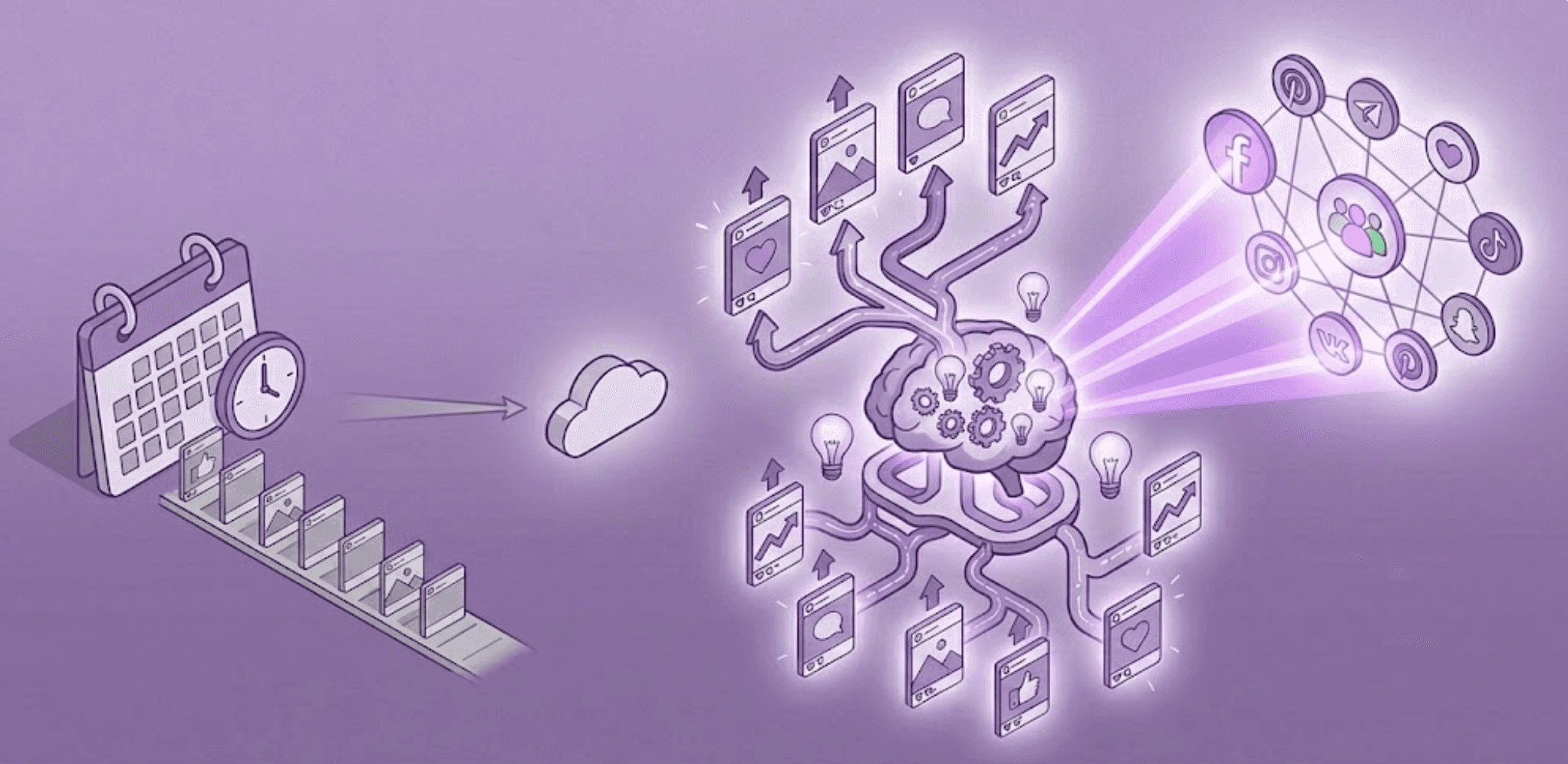
From scheduling tools to content systems
The natural evolution of scheduling is integration.
Instead of isolated tools, creators are adopting systems that connect:
- Strategy and themes (quarterly planning → monthly themes → weekly posts)
- Drafting and review (AI-assisted writing → brand voice checking → approval flows)
- Scheduling and publishing (multi-platform calendars with format-specific optimization)
- Performance signals and iteration (analytics → insights → content adjustments)
The calendar becomes a coordination layer, not the destination.
This is where the idea of a content operating system emerges. Platforms like Bolta.ai reflect this shift by treating scheduling as part of an end-to-end workflow rather than the core feature. You don’t just schedule posts—you manage themes, draft with AI assistance, maintain brand voice, and close the feedback loop from performance to planning.

Why systems outperform effort
Effort-driven workflows rely on motivation and memory.
System-driven workflows rely on structure.
When content is organized end-to-end:
- Decisions are made once and reused (create a framework, apply it forever)
- Consistency becomes automatic (your system enforces it, not your willpower)
- Output increases without pressure (the infrastructure supports volume)
- Quality improves over time (feedback loops create iterative refinement)
Scheduling still matters, but only when it’s embedded in a system designed for how creators actually work.
James Clear’s “Atomic Habits” principle applies here: you don’t rise to the level of your goals, you fall to the level of your systems. A creator with a strong system and a basic calendar will outperform a creator with ambitious goals and a premium scheduling tool.
Real-world examples of system thinking
Consider how top creators approach content:
Example 1: The framework approach
A B2B founder creates a “Problem-Agitate-Solution” framework. Every Monday, they use this structure to turn customer conversations into LinkedIn posts. The framework eliminates decision fatigue. The scheduling tool just publishes the result.
Example 2: The content pyramid
A creator writes one long-form essay per week, then breaks it into: 5 tweets, 2 LinkedIn posts, 1 newsletter section, and 3 Instagram quotes. The essay is the system; scheduling is just distribution. One hour of creation becomes 11 pieces of content.
Example 3: The feedback loop
A SaaS marketer reviews analytics every Friday, identifies top-performing themes, and adds them to next month’s content calendar. The system learns. Scheduling just executes.
How to evolve beyond scheduling
If you’re currently relying on scheduling alone, here’s how to build a system:
- Start with idea capture — Create a swipe file or idea bank. When inspiration strikes, log it. Feed your calendar from this bank, not from daily panic.
- Build reusable frameworks — Identify 3-5 post structures that work for you. Apply them repeatedly.
- Connect your tools — Use platforms that integrate planning, drafting, and scheduling. Reduce copy-paste friction.
- Create feedback loops — Review what worked monthly. Double down on winning themes.
- Automate the routine — Use AI for first drafts, repurposing, and format adaptation. Save your creativity for strategy and refinement.
The goal isn’t to replace scheduling—it’s to make scheduling the easiest part of your workflow.
The long-term takeaway
Social media scheduling solved yesterday’s problem: posting consistently without being online all day.
Today’s challenge is coordination, consistency, and sustainability at scale across multiple platforms and formats.
Structure beats effort.
Systems outperform discipline.
Content works best when it’s organized from idea to publication, not just placed on a calendar.
The creators who thrive in 2026 aren’t the ones with the best scheduling tools. They’re the ones who’ve built end-to-end systems where scheduling is just one integrated step.
If you’re ready to move beyond scheduling and build a complete content operating system, explore how Bolta.ai connects strategy, creation, and distribution in one workflow.