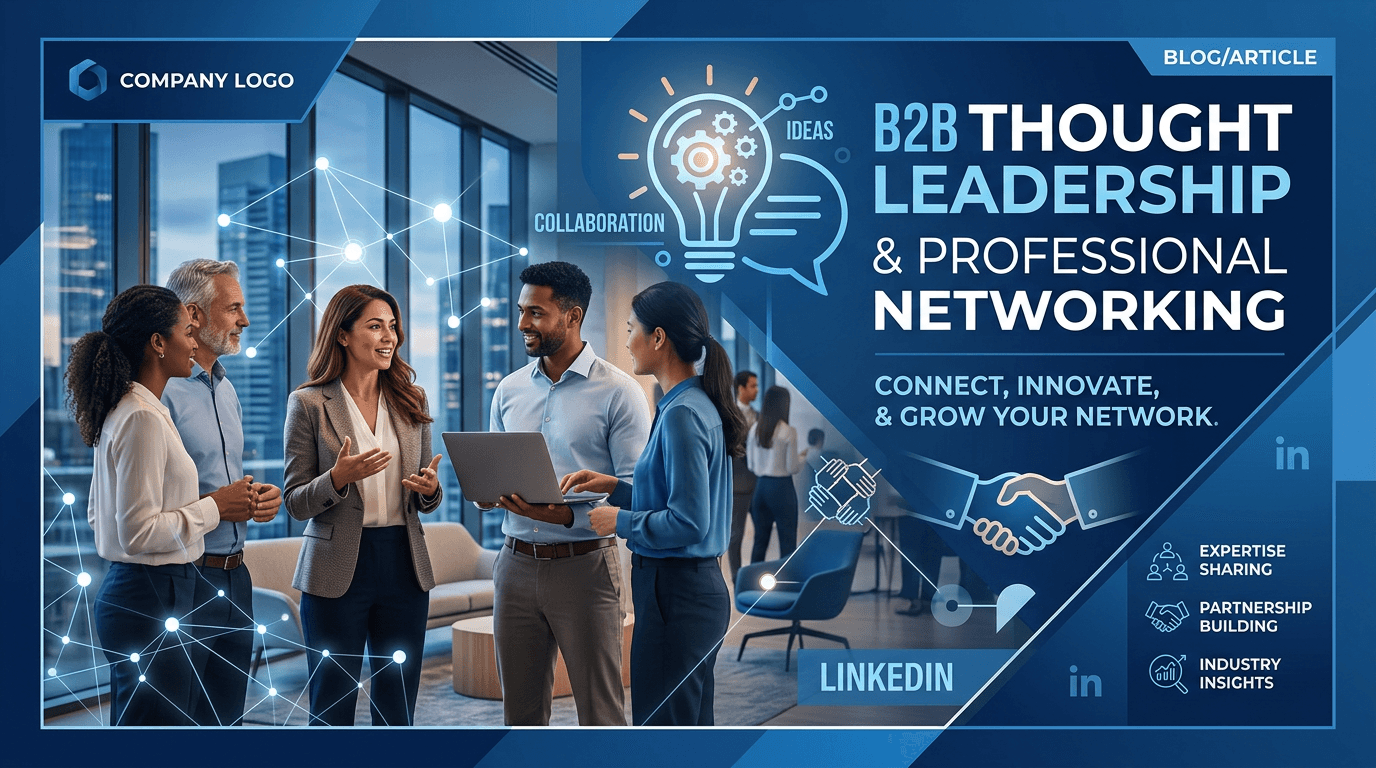
Personal profiles get 8x more engagement than company pages on LinkedIn. Thought leadership posts see 2-3x higher engagement than brand posts. LinkedIn drives 277% more B2B leads than other social channels. The math is clear: LinkedIn is the most powerful B2B platform—if you can consistently post high-quality thought leadership content.
Here’s the problem: thought leadership requires deep expertise AND consistent posting AND authentic engagement. That’s 10+ hours per week for founders and executives who barely have 10 hours to spare. Most B2B companies try to maintain a LinkedIn presence, fail to post consistently, and watch engagement drop to zero.
AI agents offer a different approach: train an AI on YOUR expertise, let it write thought leadership in your voice, post 3-5x per week without your daily involvement, and engage authentically with your network. You focus on strategy; the AI handles execution.
Why LinkedIn Demands a Different Content Strategy
LinkedIn isn’t Instagram. It’s not about pretty visuals or viral trends. LinkedIn is a professional network where trust-building matters more than reach. B2B buyers spend months researching vendors before they book a call. Your LinkedIn content is where that trust begins.
The 2026 LinkedIn Algorithm Breakdown
LinkedIn’s algorithm prioritizes relationships and recency, just like Instagram. But the ranking signals are different. LinkedIn favors depth over entertainment, conversations over quick likes, and long-form content over flashy visuals.
- Relationships: Posts from people you’ve interacted with (likes, comments, DMs) get prioritized
- Native video: Video content uploaded directly to LinkedIn ranks higher than external links
- Dwell time: Long-form posts that hold attention (500-1,000 words) get boosted
- Comments and conversations: Posts that spark discussions get amplified
- Employee advocacy: When your team engages with your posts, LinkedIn amplifies reach exponentially
Thought Leadership = Trust-Building for High-Ticket B2B
B2B buyers don’t impulse-purchase $50K software licenses. They research for months. They read reviews, compare competitors, and follow industry experts. Thought leadership content is how you become one of those experts.
But here’s the bottleneck: founders and executives don’t have 10 hours per week for LinkedIn content.
The Traditional LinkedIn Strategy (And Why It’s Hard to Scale)
Every LinkedIn guru says the same thing: post 3-5 times per week, mix content types (text posts, carousels, video), use 3-5 hashtags (broad + niche + branded), engage in comments within the first hour, activate employee advocacy, and DM prospects for social selling.
All of that works. The problem? It requires consistent human time and expertise.
The Manual Workflow Breakdown
Here’s what it actually takes to execute a traditional LinkedIn strategy:
- Research topics (industry news, competitor moves, customer pain points)
- Draft thought leadership posts (500-1,000 words each)
- Create carousels (design 5-10 slides with data points, insights, visuals)
- Script and record video content (30-60 sec LinkedIn native video)
- Edit and refine until it sounds professional but authentic
- Schedule posts at optimal times (8-10am EST for B2B audiences)
- Coordinate employee advocacy (send posts to team, ask them to share)
- Cross-post to personal profiles and company page
- Respond to comments within the first hour (algorithm boost)
- Reply to DMs from inbound leads
- Comment on industry posts (stay top-of-mind in your network)
- Participate in LinkedIn groups and conversations
- Review post performance (impressions, engagement rate, click-throughs)
- Adjust strategy based on what’s working (more video? longer posts? different topics?)
- Track leads generated (LinkedIn → website → CRM)
Total: 14-24 hours per week.
For a $150/hour executive, that’s $2,100-$3,600 per week. Over a year, that’s $109,200-$187,200 in opportunity cost. Most founders don’t have that time, so LinkedIn gets deprioritized, posting becomes sporadic, and engagement drops.
The Agentic Approach: AI Agents for LinkedIn Thought Leadership
What if your AI agent could write thought leadership posts in your voice, post consistently 3-5x per week without your manual input, engage authentically in comments and DMs, and adapt to algorithm changes automatically?
This isn’t a scheduling tool that drafts posts for your approval. This is a truly autonomous agent that acts as you—trained on your expertise, aligned with your brand pillars, posting and engaging without your daily involvement.
How It Works
Bolta’s Differentiation
Most LinkedIn tools are scheduling tools. You draft the post, the tool schedules it. That’s automation, but it’s not agentic.
- Don’t require manual drafts (they generate content themselves)
- Don’t wait for approval on every post (they execute your strategy independently)
- Don’t just schedule posts (they engage, reply, optimize, and learn)
The difference: a scheduling tool saves you 2 hours/week. An AI agent saves you 10-15 hours/week.
Real LinkedIn Strategy Examples AI Agents Can Execute
Thought Leadership Carousel Posts
AI agents generate multi-slide carousels from your whitepapers, reports, or blog posts. These are high-engagement content formats on LinkedIn.
- Slide 1: Hook (“We went from $0 to $5M ARR in 3 years. Here’s what we learned.”)
- Slide 2-6: Each lesson with data points (Lesson 1: “Ship fast, iterate faster — our best features were built in 2 weeks”)
- Slide 7: CTA (“Building a SaaS? Let’s connect.”)
The AI pulls lessons from your blog posts, formats them into slides, and posts as a carousel. You don’t design slides manually; the AI handles it.
Industry Commentary & Hot Takes
AI agents monitor industry news and write your take on trending topics. This positions you as a thought leader who’s plugged into what’s happening.
- LinkedIn post: 600-word breakdown of the event, your analysis, what it means for your audience
- AI scrapes news, writes the post in your voice, posts within 24 hours (while the topic is still trending)
You’re not reading industry news every morning and drafting hot takes manually. Your AI does it.
Case Study Storytelling
AI pulls from customer success stories and formats them as narrative posts. These are trust-building posts that show real results.
- LinkedIn post: Story format (customer’s challenge → solution → results → testimonial)
- AI pulls data from your CRM or case study docs, writes the story, posts it
You don’t manually write case studies every week. Your AI extracts the stories and shares them.
Employee Advocacy Campaigns
AI drafts posts for team members (tailored to each person’s role and voice) and coordinates campaign timing. If 15 employees post the same week, you get 15x reach.
- AI writes 15 unique LinkedIn posts (one per employee) about the launch
- Each post is personalized (engineer’s POV vs sales rep’s POV vs customer success POV)
- Posts go out over 3 days (not all at once, to avoid spam signals)
- Result: 15x the impressions of a single company page post
You don’t manually draft 15 posts or coordinate timing. Your AI handles it.
Measuring Success
Key Metrics
Bolta Analytics
AI agents track performance automatically. They analyze which posts get the most engagement, which topics resonate, which posting times drive the most reach. They A/B test post types (carousels vs text vs video) and optimize your strategy over time.
You don’t manually review analytics every week. Your AI does it and adjusts automatically.
Getting Started with AI-Powered LinkedIn Strategy
Step 1: Define Your Thought Leadership Pillars
Pick 3-5 core topics you want to own on LinkedIn. These should align with your expertise and business goals.
- AI in business operations
- SaaS scaling strategies
- Product development best practices
- Customer success stories
- Founder lessons learned
Your AI will generate content around these pillars. If a topic doesn’t fit one of your pillars, the AI won’t post about it.
Step 2: Train Your AI Agent
- Past LinkedIn posts (your best-performing posts)
- Blog articles you’ve written
- Whitepapers or reports
- Presentations or webinar scripts
- Customer case studies
The AI learns your voice, expertise, and style. It doesn’t write like a generic AI—it writes like you.
Step 3: Set Posting Frequency
How often do you want to post? For B2B thought leadership, 3-5x per week is the sweet spot. Posting daily can work, but only if quality stays high. Posting 1x per week is too sporadic—the algorithm won’t prioritize your content.
Step 4: Enable Autonomous Engagement
- Reply to comments within 1 hour (boosts algorithm ranking)
- Respond to DMs from leads (qualify, route to your calendar)
- React to posts in your network (stay top-of-mind)
You can set engagement rules (e.g., “Only reply to comments from decision-makers at target companies”) so the AI doesn’t engage with spam.
Step 5: Review Analytics Monthly
- Which posts got the most engagement?
- Which topics resonated with your audience?
- How many leads came from LinkedIn this month?
- What adjustments should the AI make?
Refine your strategy quarterly. Double down on what’s working.
LinkedIn is the most powerful B2B platform, but it’s also the most time-intensive. Thought leadership requires expertise, consistency, and engagement—10+ hours per week for most executives.
AI agents change the equation. Train an AI on your expertise, let it write in your voice, post 3-5x per week without your daily involvement, and engage authentically with your network. You focus on closing deals; the AI handles the content grind.
The question isn’t whether LinkedIn works for B2B (it does). The question is: do you have 10 hours per week to make it work? If not, an AI agent might be the leverage you need.
- AI social media for B2B businesses
- Manage multiple LinkedIn profiles for clients
- How Bolta’s AI agents work
- Build your AI workforce
- LaGrowthMachine: LinkedIn B2B Strategy Guide (cite stat: personal profiles 8x engagement)
- Hootsuite 2026 Social Media Trends Report (cite stat: 79% use AI daily)
- LinkedIn Marketing Labs: Official algorithm insights