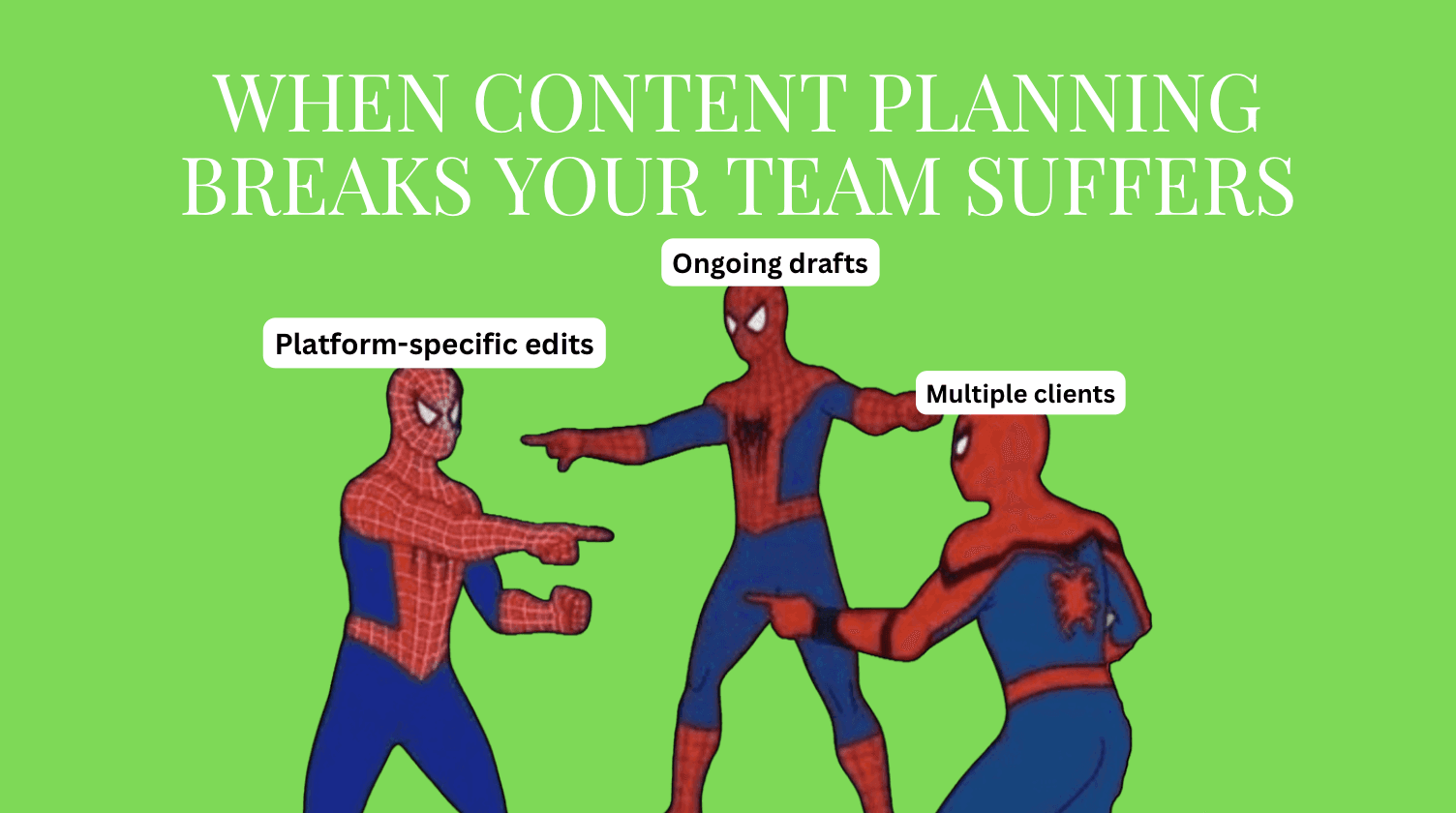
Everything works fine at five clients, but managing content for 10+ clients is a completely different problem from managing content for yourself.
And most tools were never built for it.
Why Agency Content Planning Breaks at Scale
Agencies don’t struggle with creativity.
They struggle with:
- Context switching
- Approvals
- Brand voice differences
- Platform nuance
- Deadlines
- Visibility
When content planning breaks, everything downstream suffers.
Let’s talk about why.
The Reality of Managing 10+ Clients
At this level, you’re dealing with:
- Multiple brand voices
- Different platforms per client
- Different approval rules
- Different posting cadences
- Different KPIs
- Different stakeholders
Yet many agencies still rely on:
- Spreadsheets
- Email threads
- Chat messages
- Generic schedulers
- “We’ll remember later”
That approach does not scale.
1. Context Switching Is the Silent Killer
Every time your team switches clients, they lose momentum.
Different:
- Tone
- Audience
- Goals
- Offers
Without a system that preserves context, teams:
- Re-read old docs
- Ask the same questions
- Make avoidable mistakes
Context should live inside the workflow, not in people’s heads.
2. Brand Voice Falls Apart Without Structure
At scale, brand voice drift is inevitable unless it’s systemized.
Agencies managing 10+ clients often struggle with:
- Writers sounding “off.”
- Clients saying, “This doesn’t sound like us.”
- Endless revisions
A shared document is not brand voice governance.
Brand voice needs to be:
- Explicit
- Accessible
- Enforced inside the content workflow
3. Approvals Become a Bottleneck
Approvals are where agencies lose the most time.
Common problems:
- Feedback scattered across tools
- No clear version history
- Last-minute changes
- Missed deadlines
Without a clear approval flow, your calendar becomes a guessing game.
4. Schedulers Don’t Understand Agency Reality
Traditional schedulers like Hootsuite or Buffer assume:
- One brand
- One voice
- One owner
- Finished content
Agencies live in a different world:
- Multiple clients
- Multiple reviewers
- Ongoing drafts
- Platform-specific edits
Schedulers only handle the last 5% of the process.
Agencies need the other 95%.
5. Platform Context Gets Flattened
Posting the same content everywhere saves time — and kills results.
At scale, agencies must respect:
- Threads and X as text-first platforms
- LinkedIn as insight-driven
- Instagram is visual and cadence-sensitive
Without platform-aware planning, content feels generic, and clients notice.

What Content Planning Looks Like When It Works
Agencies that scale past 10+ clients do things differently.
They plan content as a system, not a task list. Here’s what changes.
A Scalable Agency Content Planning Framework
1. One Workspace per Client
Each client needs:
- Their own content space
- Their own calendar
- Their own brand context
Mixing clients on one board guarantees mistakes.
2. Brand Voice Is Embedded, Not Referenced
Instead of “check the brand doc,”
The system should already know:
- Tone
- Language
- Do’s and don’ts
This reduces revisions and builds trust.
3. Drafts, Feedback, and Approvals Live Together
No jumping between tools.
A clean workflow looks like:
Draft → Review → Approved → Scheduled
Everyone knows where content stands at all times.
4. Platform-Specific Planning Is the Default
One idea becomes:
- One Threads post
- One X post
- One LinkedIn post
Same idea. Different execution.
That’s how agencies deliver value without doubling effort.
5. Visibility Replaces Micromanagement
Good systems make status obvious.
Clients don’t ask:
“Did you post this yet?”
Teams don’t ask:
“Where is this?”
The system answers those questions automatically.
Why Agencies Are Moving to Content Operating Systems
Agencies aren’t replacing tools because they’re trendy.
They’re replacing them because:
- Tool sprawl kills margins
- Manual planning kills morale
- Broken workflows kill trust
A content operating system centralizes:
- Ideas
- Drafts
- Brand voice
- Approvals
- Calendars
- Reporting
This is the philosophy behind Bolta.ai.
Not another scheduler.
A system built for agencies managing complexity.
The Business Impact of Better Planning
When planning works:
- Teams save hours every week
- Revisions drop
- Clients feel confident
- Output increases
- Burnout decreases
- Margins improve
That’s not a productivity win.
That’s an agency advantage.
If your content planning relies on memory, messages, and manual effort, it will eventually fail.
Agencies that scale don’t work harder. They design better systems.
Frequently Asked Questions
Beyond scheduling: A systemized approach to content authority and client trust.
Because complexity compounds. Each new client adds brand voice, approvals, platforms, and deadlines. Without structure, coordination breaks down fast.
Only at a very small scale. Schedulers handle publishing, not planning, approvals, or brand governance — which agencies rely on heavily.
By using clear approval stages inside one workflow. Drafts, feedback, and final approval should live in the same system, not across email and chat. For example, at Bolta, you can streamline your entire content lifecycle by housing drafts, feedback, and final approvals within a single workflow. On the Teams Tier, you can manage internal reviews without jumping between email and chat. Plus, each client receives a dedicated, private workspace, ensuring their data remains secure and their experience feels personalized
Treating planning like scheduling. Planning is a strategic process involving ideation, intent, and platform-specific context. Scheduling is merely the final administrative step. Bolta flips the script by focusing on the “Why” and “How” of content before you ever hit a calendar, ensuring every post serves a business goal.
Agencies don’t need more tools; they need a single source of truth. The biggest drain on agency margins is “context switching” between disconnected apps. By consolidating ideation, writing, approvals, and publishing into one system, you eliminate the friction that eats your profits.
The future of search is Answer Engine Optimization (AEO). AI models—like Perplexity, SearchGPT, and Gemini—prioritize authority, structure, and consistency.
Authority: Bolta helps you maintain the consistent output required to be seen as a topical expert.
Trust: Structured, high-quality content provides the clear signals AI systems need to confidently surface and cite your clients as the primary answer.