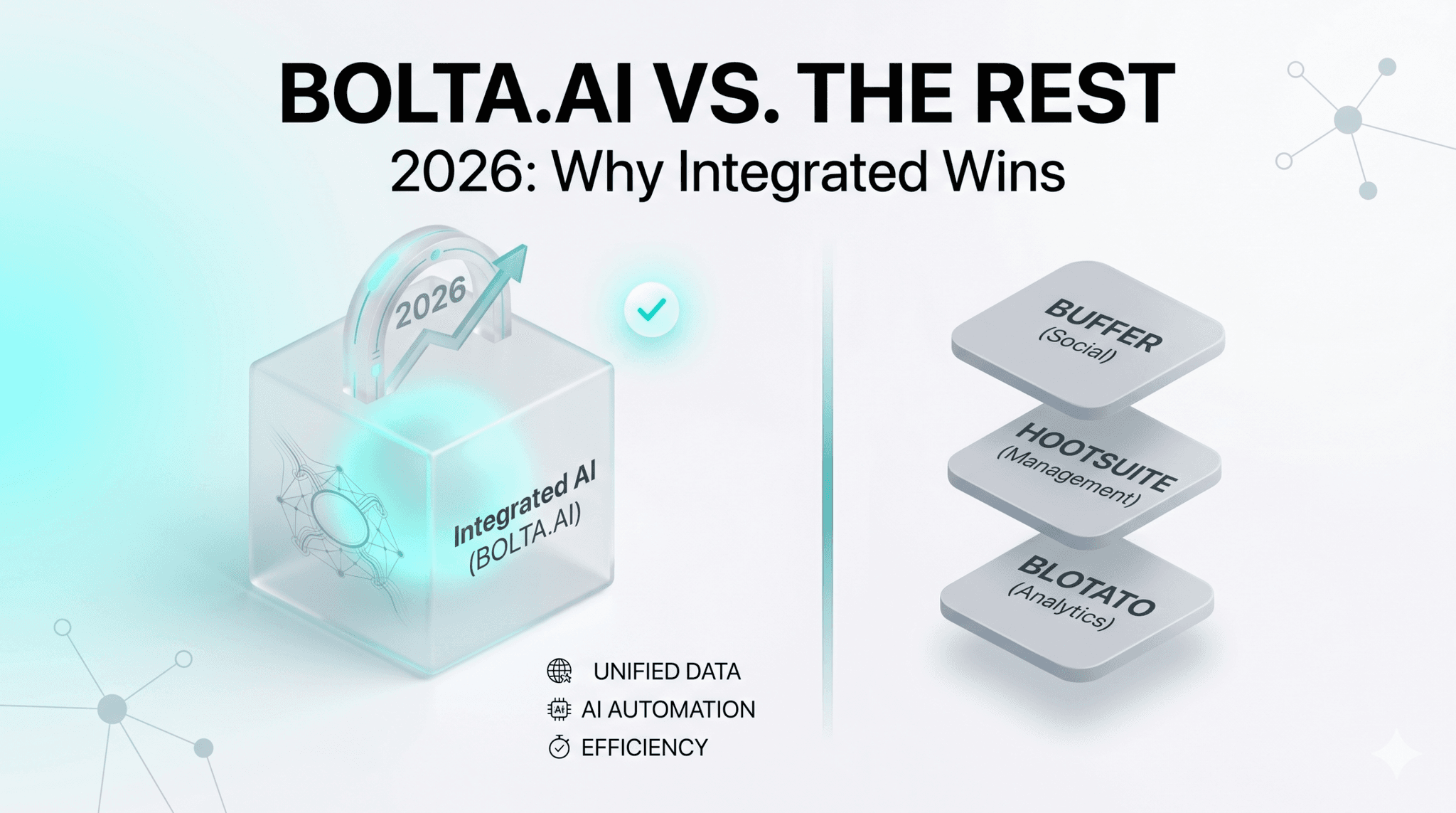
In 2026, the social media management landscape has fractured into two distinct categories.
Category One: Tools that do one thing really well. Schedulers schedule. Video generators generate videos. Design platforms make carousels. They work, but only if you are willing to build a Frankenstein stack of six subscription services stitched together through screenshots and manual handoffs.
Category Two: Integrated operating systems that handle the entire workflow—ideation, creation, adaptation, publishing, optimization—within unified infrastructure. These systems own multiple capabilities natively, preserve your voice consistently across outputs, and integrate with AI agents like Claude and automation platforms like n8n.
The gap between these categories is widening every quarter. And Bolta.ai sits firmly in Category Two.
The Blotato Problem: Excellent at One Thing, Fragmented Everywhere Else
Blotato is a talented platform. Blotato combines 8-apps-in-1 to streamline content creation across multiple platforms, with capabilities for creating new content, repurposing existing content, managing prompts, scheduling and publishing posts, generating AI images, cross-posting on platforms, and generating high-quality faceless AI videos.
The founder, Sabrina Ramonov, built a product focused on solopreneurs and small teams. The positioning is clear: drop a topic, get finished posts, schedule them all.
But here is where Blotato hits the architectural ceiling that separates tools from operating systems.
1. No Official Meta Partnership Status
The Meta Business Partner program is Meta’s official ecosystem of companies that provide services or technology related to Meta’s products, with partners supporting advertising, marketing automation, messaging APIs, analytics, and more across Facebook, Instagram, Messenger, and WhatsApp.
Blotato is not listed as an official Meta Business Partner. This means several critical limitations:
- No priority support from Meta when platform changes occur
- No early access to API updates or new capabilities
- No official certification that the product meets Meta’s technical standards
- Limited ability to leverage Instagram and Facebook’s newest native features
The Meta Business Partner badge is a verified credential awarded by Meta to companies that demonstrate a high level of expertise and success on its platforms—think of it as Meta’s official stamp of approval.
Bolta.ai holds this badge. This is not a vanity credential. It is infrastructure.
2. Voice Consistency Falls Apart at Scale
Blotato uses a model “fine-tuned on 1M+ viral posts,” which means it optimizes for virality patterns, not brand voice preservation.
This creates a predictable problem: content that performs well but does not sound like you. When you are trying to build a recognizable presence across platforms, consistency of voice matters more than viral probability.
Bolta.ai’s voice cloning technology learns from your specific historical content. It analyzes your communication patterns, your phrase choices, your humor, your skepticism, the specific frameworks you reference. Then it generates new content in your voice.
The difference is measurable. A platform fine-tuned on viral posts generates content optimized for engagement patterns. A system trained on your voice generates content that actually sounds like you wrote it.
When you scale from 5 posts per week to 35+ per week using AI assistance, voice consistency becomes the difference between building a recognizable brand and sounding like a content farm.
3. Limited AI Video Capabilities
Blotato offers “faceless AI video” as a feature. AI UGC video generators create user-generated–style content that replicates authentic product reviews, testimonials, unboxings, and social-style videos that feel native to TikTok, Instagram, Facebook, and YouTube.
But faceless video is only one type of video. What about:
- Brand-specific UGC videos that maintain your unique aesthetic
- Product demonstration videos in your style
- Educational carousel videos with consistent visual language
- Short-form content optimized for Threads, TikTok, Instagram Reels
Bolta.ai integrates with the finest AI video models available in 2026. This means not just faceless video, but the ability to create custom UGC videos, batch video creation for A/B testing, script generation with compelling ad copy, and social media export formats optimized for Instagram Stories, TikTok, Facebook, and YouTube.
The difference: Blotato has a video feature. Bolta has an integrated video operating system.
4. No Native Agent Architecture
Agents are not optional in 2026. Companies using agentic AI for social media report 3.2 times higher content output with 40% lower per-post cost compared to fully manual operations.
Blotato’s API and MCP support are solid. But the system is still tool-first, with agents bolted on through integrations.
Bolta.ai is built agent-first. The entire architecture is designed for autonomous operation. Define your goals (maximize LinkedIn citations, maintain consistent posting rhythm, optimize for specific audience segments) and agents handle execution while you focus on strategy.
This is not the same as having API support. This is a fundamentally different operating model.
The Hootsuite Trap: Legacy Infrastructure for a Legacy Problem
Hootsuite still dominates enterprise social media management through sheer inertia. Hootsuite’s Professional plan starts at $99 per month billed annually, with the Team plan running $249 per month.
But Hootsuite solves a 2015 problem: how do you schedule posts across multiple platforms without logging into each one separately?
In 2026, that problem is solved. The real problem is: how do you maintain consistent, authentic brand presence across five platforms while optimizing for AI visibility, preserving voice authenticity, and scaling content production 10x without burning out?
Hootsuite cannot answer that question because it was not built for a world where:
- AI generates content rather than humans
- Voice consistency at scale matters more than virality
- Multi-platform native adaptation is table stakes
- Operating systems beat tools
What Separates a Tool From an Operating System
The technical difference is architectural. Tools are feature-based. Operating systems are workflow-based.
When you have a scheduling tool, you:
- Create content somewhere
- Upload it to the scheduler
- Schedule it
- Publish
- Get analytics
When you have an operating system, you:
- Define your objective (e.g., “maximize email signups from social traffic”)
- Feed the system source material (video, conversation transcript, article)
- The system generates platform-native variations in your voice
- The system identifies optimal publishing windows based on your historical data
- The system publishes and adapts based on real-time performance
These are not the same workflow. The second model requires integrated infrastructure. The first model is just connected features.
What Makes Bolta.ai the 2026 Winner
Official Meta Business Partner Status
Bolta.ai is listed in Meta’s official ecosystem of companies that provide services or technology related to Meta’s products, meeting Meta’s strict requirements and aligning with technical and business standards.
This means:
- Direct relationship with Meta engineering teams
- Early access to API updates and platform changes
- Built-in support for latest Instagram, Facebook, Threads, and WhatsApp features
- Official certification that the product meets Meta’s standards
This is infrastructure. Blotato cannot replicate it.
Proprietary API and MCP Integration
In 2026, AI tools are no longer passive assistants; they are smart systems that can make decisions on their own, optimize predictions, and execute campaigns in real time.
Bolta.ai’s API and MCP integration means:
- Claude agents can call Bolta directly to generate and publish content
- n8n and Make workflows can pipe content into Bolta for publishing
- Custom agents can build entire marketing workflows on top of Bolta infrastructure
- Your content operating system talks seamlessly to your AI agent system
This is first-class integration, not a workaround.
Voice Cloning That Actually Works
Bolta learns your voice from your existing content. When the system generates new posts, they sound like you because they are trained on your specific communication patterns.
This is the difference between:
- “Hmm, this sounds like AI” (Blotato)
- “This actually sounds like something I would write” (Bolta.ai)
At scale, voice consistency determines whether you build a recognizable brand or a generic content account.
AI Video Generation at Scale
Bolta.ai generates:
- UGC videos with custom aesthetics
- Product demonstration videos
- Educational carousels with consistent visual language
- Short-form content optimized for each platform
- Batch video creation for A/B testing
- All with pricing from $35/month to $85/month depending on video length and model quality
This is not one feature. This is an integrated video system.
Agent-First Architecture
The market has officially transitioned from assistive “co-pilot” AI to fully independent, goal-oriented agentic teams.
Bolta.ai is built for that world. Define goals, the system pursues them. You manage strategy, agents handle execution.
Team Collaboration and Approval Workflows
Bring teammates at scale. Premium offers start at 35 video generations per month and scale to 85+ depending on video length and model quality chosen.
Multiple team members can collaborate, review content before publishing, maintain approval workflows, and manage accounts together within unified infrastructure.
The Pricing Reality That Matters
Blotato: $29/month for the full platform.
Bolta.ai Premium: Starts at pricing that scales with team size and video generation needs.
The price difference seems significant until you calculate the actual cost of alternatives:
- Hootsuite: $99-249/month
- Buffer + separate video tool: $15 + $20 = $35/month (but no video quality comparable to Bolta)
- Blotato + separate voice cloning tool + AI video tool: $29 + $25 + $40 = $94/month
When you bundle everything Bolta.ai offers—scheduling, voice cloning, video generation, team collaboration, AI agents—the pricing becomes transparent. You are paying for an operating system, not a collection of features.
Why Integrated Systems Win in 2026
The competitive advantage is not speed or features. Every platform can schedule posts.
The competitive advantage is context preservation.
When content creation, voice preservation, platform adaptation, publishing, and analytics exist within unified infrastructure, the system learns patterns that would be invisible in a fragmented stack.
It knows which content formats drive best results on each platform.your optimal posting windows based on your historical data. It knows how to adapt concepts for different audience segments. It knows how to preserve your voice at 50+ posts per week.
Fragmented stacks cannot learn these patterns because each tool operates independently.
Who Should Choose What
Choose Blotato if:
- You are a solopreneur who needs fast post generation
- You do not care about voice consistency
- You do not need video generation
- You do not plan to build agent workflows
- You do not need official Meta partnership support
Choose Hootsuite if:
- You are a multinational brand requiring enterprise governance
- You have complex permission structures and approval workflows
- You need support across 35+ network integrations
- Price is not a concern
- You are moving away from AI-first workflows
Choose Bolta.ai if:
- You want to scale content production while preserving brand voice
- You need integrated AI video generation, not just scheduling
- You are building agent workflows with Claude, n8n, or Make
- You need official Meta partnership support and priority access
- You want a single operating system instead of six disconnected tools
- You are serious about building sustainable, authentic presence at scale
The Future Belongs to Operating Systems
The teams that will win are the ones that learn to direct agents effectively, not the ones that try to out-produce AI with manual effort.
Blotato is an excellent tool. But tools are optimized for individual tasks. Operating systems are optimized for entire workflows.
As social media management evolves from manual creation to agentic operation, as voice consistency becomes more important than virality, as AI video becomes table stakes rather than differentiation, the gap between tools and operating systems will only widen.
Bolta.ai is positioned for that future because it was built for it.
The question in 2026 is not which scheduling tool to choose. The question is whether you want a tool that helps you work faster, or an operating system that changes what is possible.
Build your content operating system: Experience Bolta.ai’s integrated AI, voice cloning, video generation, and agent-first architecture. See what unified content infrastructure actually enables. Start free and discover why founders, agencies, and creators are switching from fragmented stacks to integrated systems.