Social media automation has a reputation problem.
Companies automate their content to save time, then suddenly every post sounds like it was written by the same generic marketing department.
The sentences are polished.
The grammar is perfect.
And somehow the personality is gone.
That is not an automation problem. It is a workflow problem.
The goal of social media automation should not be to remove humans from your content. The goal is to remove repetitive work while preserving the ideas, opinions, context, judgment, and voice that make the content worth following.
Here is how to do it.
What should social media automation actually automate?
Social media automation works best when it handles repetition rather than judgment.
A good system can help with:
- turning one idea into multiple platform-specific posts
- scheduling content
- adapting posts for different networks
- organizing drafts
- maintaining a content calendar
- suggesting replies
- analyzing performance
- identifying content that can be reused
- maintaining consistent publishing
But automation becomes dangerous when it starts making every creative decision for you.
Your opinions should still come from you.
Your experience should still come from you.
Your stories should still come from you.
AI should help distribute those ideas more efficiently.
That distinction matters.
Why automated social media often sounds robotic
The problem usually starts before the AI generates anything.
Most AI tools receive a prompt like:
Write a LinkedIn post about entrepreneurship.
There is almost no context.
The system does not know how the founder normally speaks, what they believe, which phrases they use, what they avoid, who the audience is, or what the business is trying to accomplish.
So the AI fills in the missing information with patterns it has seen elsewhere.
That is when you get content like:
In today’s fast-paced digital landscape, authenticity is more important than ever.
Technically correct.
Completely forgettable.
The solution is not simply writing better prompts.
You need a system that remembers context.
1. Define your voice before automating it
Before asking AI to create content, establish what your brand actually sounds like.
Your brand voice should include things such as:
Tone
Are you conversational, analytical, funny, provocative, educational, direct, formal, technical?
Vocabulary
What words do you regularly use?
What words would you never use?
Sentence structure
Do you write short sentences?
Long explanations?
Stories?
Strong opinions?
Point of view
What does your company believe that competitors might disagree with?
This is especially important for founder-led brands.
Your strongest content usually comes from having a recognizable point of view.
Automation should amplify that point of view, not replace it.
2. Start with an original idea
Do not ask AI:
Give me 20 posts.
Start with something real.
Maybe you just had a conversation with a customer.
Maybe a feature failed.
Maybe you learned something while building your company.
Maybe you disagree with a popular piece of advice.
Your original input could be as simple as:
We realized our customers were not struggling to create content. They were struggling to distribute it consistently across every platform.
That contains an actual idea.
AI can now help turn that idea into:
- a LinkedIn post
- a Threads post
- an X post
- a short video script
- a carousel
- a newsletter section
The source idea remains yours.
Automation handles the transformation.
3. Repurpose instead of constantly generating
This is one of the biggest opportunities in AI social media automation.
Most teams think they need more ideas.
Usually they need better distribution.
One useful founder insight might become:
Monday
LinkedIn story explaining the idea.
Tuesday
Threads post summarizing the lesson.
Wednesday
Short video explaining the same concept.
Thursday
Carousel breaking the idea into steps.
Friday
Follow-up post answering a question from the comments.
That is not five random pieces of content.
It is one idea distributed five different ways.
This is where automation becomes extremely useful because the repetitive transformation can happen quickly while the underlying thinking remains human.
4. Give AI context, not just instructions
Compare these two prompts.
Prompt A
Write an Instagram post about social media automation.
Versus:
Prompt B
Our audience is SaaS founders with small teams. They want to publish consistently but do not have time to manage five networks. We believe AI should automate distribution, not replace the founder’s opinions. Write this in a direct, conversational tone using short sentences and no marketing clichés.
The second result will usually be much closer to the intended voice.
The difference is context.
A proper AI social media manager should understand more than the individual prompt.
It should understand:
- your company
- your audience
- previous content
- your tone
- your goals
- your products
- your positioning
- your publishing workflow
That is how automation starts becoming useful instead of generic.
5. Separate creation from approval
Automation does not have to mean automatic publishing.
This is especially important for agencies, founders, regulated businesses, and larger teams.
A stronger workflow looks like this:
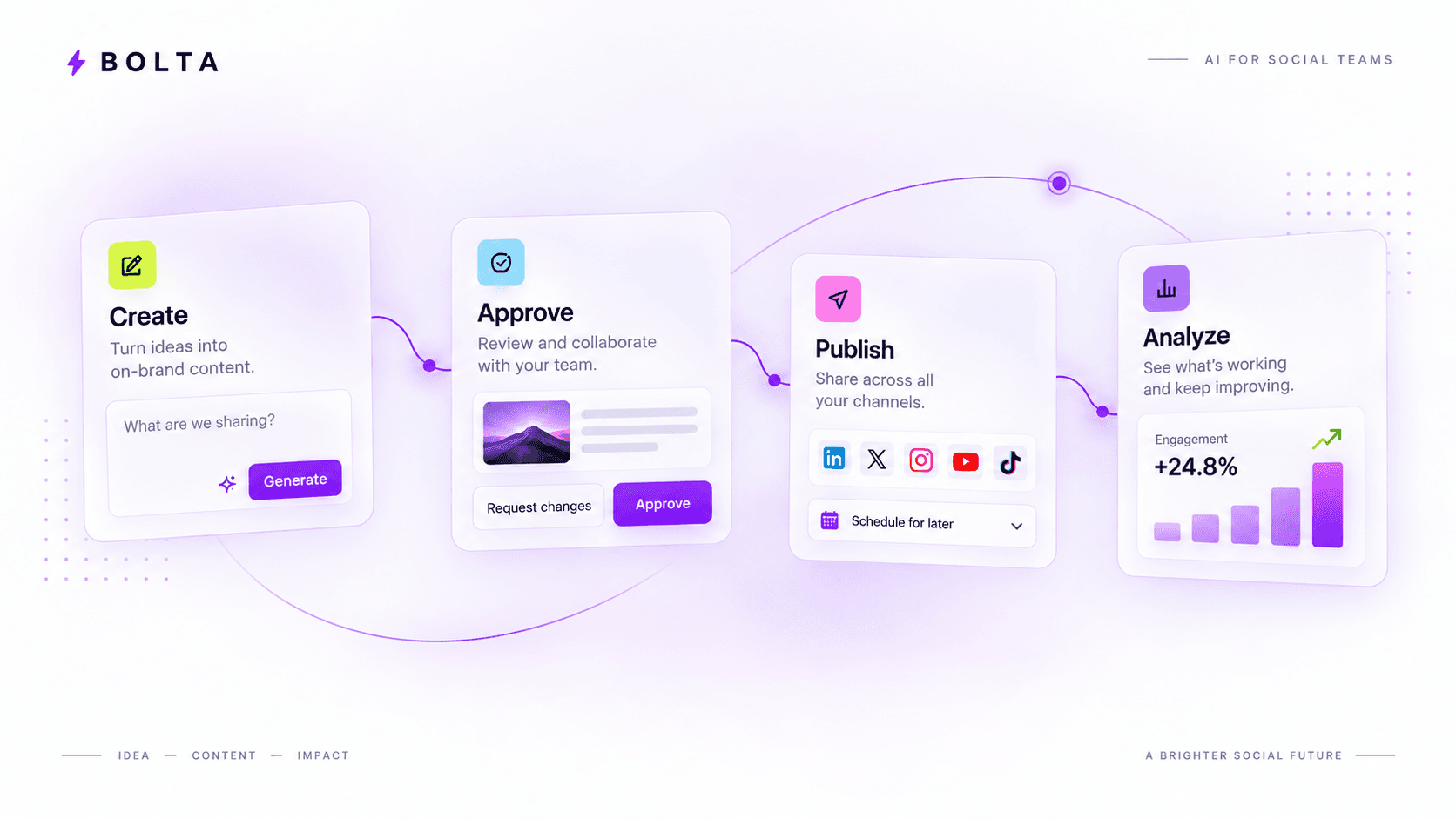
Idea → AI draft → human review → approval → scheduling → publishing → analysis
Some content may eventually become safe enough to publish automatically.
Other content should always require approval.
The important thing is that you decide where humans belong in the workflow.
Do not automate everything just because you can.
6. Create rules for what AI should never change
Every brand should have boundaries.
For example:
AI may be allowed to:
- shorten a post
- create variations
- adapt a post for another platform
- suggest hooks
- improve clarity
- create caption options
But it may not be allowed to:
- invent customer results
- create fake personal experiences
- fabricate statistics
- change the founder’s opinion
- make promises the product cannot support
- publish sensitive announcements without approval
These rules protect both the brand and the people reading the content.
7. Use performance data without becoming a robot
Analytics should influence your content.
They should not completely control it.
Suppose three posts about founder lessons perform significantly better than product announcements.
That is useful information.
You might decide to create more founder-led educational content.
But you should not simply clone the highest-performing post 20 times.
Use performance as a signal.
Ask:
Why did people care?
Was it the topic?
The format?
The story?
The opening?
The timing?
The strongest social media systems combine data with human interpretation.
Where AI should help
AI is particularly useful for work that is repetitive or structurally predictable.
That includes:
Repurposing
Turn one piece of content into multiple formats.
Scheduling
Move approved content into a consistent publishing calendar.
Platform adaptation
Rewrite the same idea appropriately for LinkedIn, Threads, X, Facebook, Instagram, and other networks.
Idea organization
Turn messy notes and ideas into usable drafts.
Performance review
Surface patterns from previous posts.
Engagement assistance
Suggest replies while using the brand’s context and voice.
These tasks consume enormous amounts of time without necessarily requiring a person to start from zero every time.
Where humans still matter
There are areas where human judgment remains essential.
Your lived experience.
Your opinions.
Your relationships.
Your sense of humor.
Your understanding of a sensitive situation.
Your willingness to say something other people will not.
Your ability to recognize when technically correct content simply does not feel right.
The best social media automation system should leave humans with more time for those things.
Not less.
What this looks like inside Bolta
Bolta approaches social media automation as a workflow rather than a single AI writing box.
Instead of repeatedly starting from an empty prompt, the goal is to maintain context around your brand and use that context throughout creation, distribution, engagement, and analysis.
For example, a founder could start with one idea.
Bolta can help turn that idea into posts for multiple networks, organize those drafts inside the content workflow, schedule approved posts, and use performance information to inform what happens next.
That is much closer to having an AI social media manager than simply using an AI caption generator.
The important part is that automation serves the brand.
The brand should not start sounding like the automation.
A simple social media automation workflow
If you are implementing this today, start small.
Use this process:
Step 1: Define your voice and audience.
Step 2: Collect real ideas from founders, customers, product conversations, sales calls, and company experiences.
Step 3: Use AI to turn those ideas into drafts.
Step 4: Repurpose strong ideas across relevant platforms.
Step 5: Review anything requiring human judgment.
Step 6: Schedule approved content.
Step 7: Analyze what performs.
Step 8: Use those insights to improve the next cycle.
You do not need to automate everything immediately.
Automate the repetitive parts first.
Then expand.
Common mistakes to avoid
The biggest mistake is measuring automation by how much content it creates.
More content is not necessarily better.
A system generating 50 generic posts is less useful than one helping you publish five strong posts that actually sound like you.
Other common mistakes include publishing without review, using the same wording across every platform, ignoring previous brand content, relying entirely on AI-generated ideas, and treating engagement as another mass-production task.
Automation should make the system more efficient.
It should not make the brand less human.
Frequently asked questions
Can you fully automate social media?
Technically, many parts can be automated, including content generation, scheduling, cross-posting, reporting, and some engagement. Most brands should still keep human oversight around strategy, sensitive responses, major announcements, and original ideas.
Does AI social media content hurt your brand voice?
It can if the AI has little context about the brand. Giving the system clear examples, voice guidelines, audience information, product context, and previous content makes automation considerably more useful.
What is the best part of social media to automate first?
Scheduling and repurposing are usually good starting points because they remove repetitive work without handing over major strategic decisions.
Can AI manage multiple social media platforms?
Yes. AI-assisted social media systems can help adapt content, schedule posts, organize calendars, analyze performance, and support engagement across multiple networks.
Is social media automation the same as scheduling?
No. Scheduling is one part of automation. Modern social media automation can also include content creation, repurposing, engagement assistance, analytics, approvals, and workflow management.
How do you automate social media without sounding robotic?
Start with original human ideas, define a clear brand voice, give AI sufficient context, keep humans involved in important decisions, and use automation primarily for repetitive distribution work.
Automation should make your voice easier to scale
The goal is not to make AI sound human.
The goal is to make it easier for your ideas to reach more people without requiring you to rebuild every post from scratch.
Your voice remains the source.
AI helps with the system around it.
If your current workflow involves jumping between documents, AI tools, spreadsheets, schedulers, analytics dashboards, and social networks, that is exactly the kind of operational work worth automating.
Explore how Bolta’s AI Social Media Manager can help you turn ideas into an organized social distribution workflow.