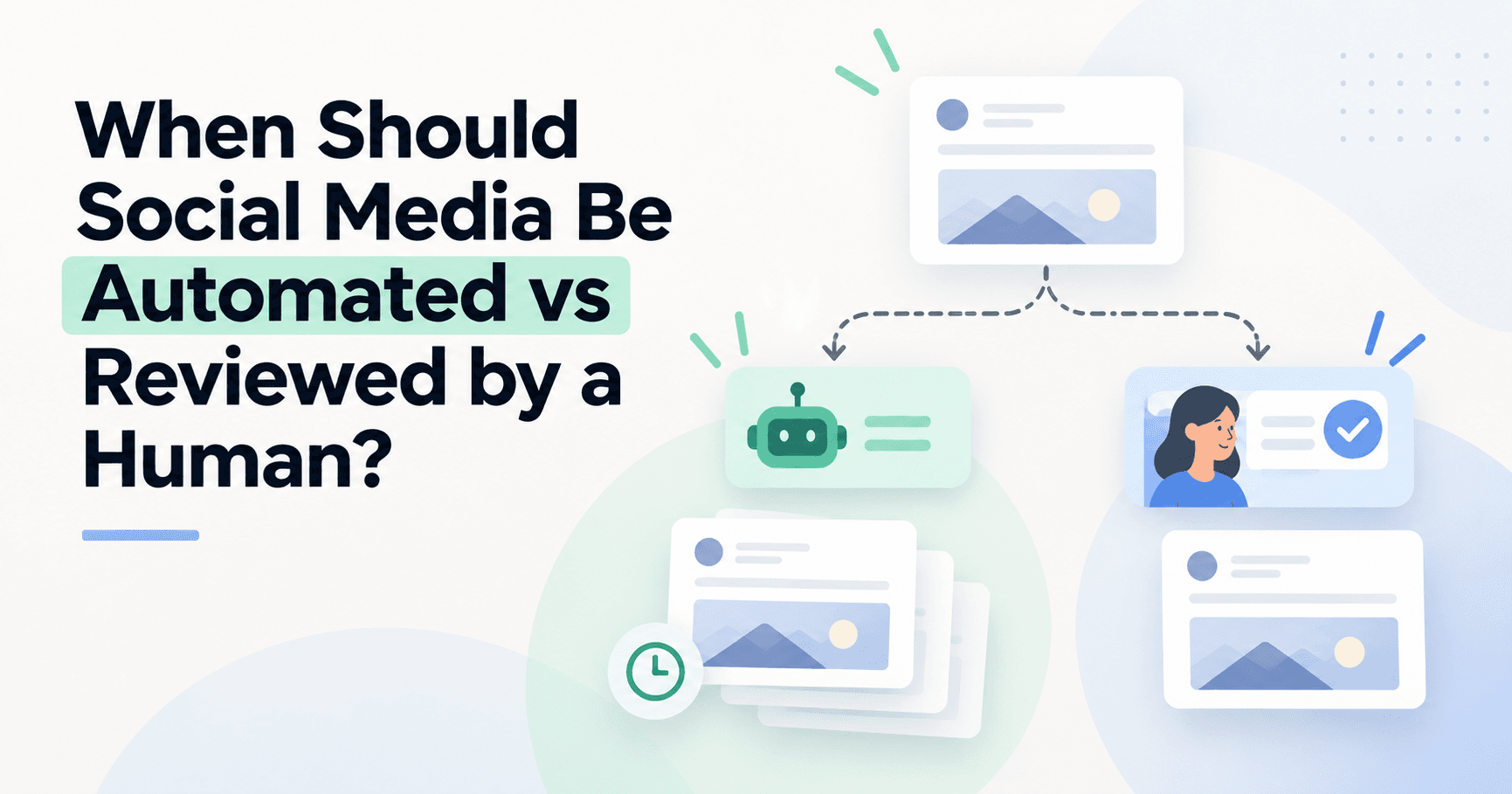
The question is not whether social media should be automated.
The useful question is which parts should be automated and where human judgment still matters.
Treating every task the same creates two bad outcomes: either the team stays buried in manual work, or automation starts making decisions it should not own.
Automate repeatable production work
Automation is strongest when the task is structured and the rules are clear.
Good candidates include:
- turning an approved source into first drafts
- adapting one idea for several platforms
- preparing recurring evergreen content
- organizing drafts
- scheduling approved posts
- summarizing performance data
This is the kind of repetitive work AI social media automation should reduce.
Keep human review where consequences are higher
Some posts require judgment because the cost of being wrong is higher.
Examples:
- customer claims
- legal or regulatory topics
- crisis communication
- sensitive founder opinions
- major company announcements
- competitive claims
- personal replies to high-value relationships
Use a risk-based framework
Ask three questions:
- How repeatable is the task?
- How costly would a mistake be?
- How much company-specific judgment does it require?
Highly repeatable, low-risk tasks are strong automation candidates.
Low-repeatability, high-risk tasks deserve more human involvement.
Example: evergreen educational content
A recurring educational series built from approved product knowledge may be safe to automate heavily, especially when the voice and source material are stable.
The team can still spot-check or review depending on its policy.
Example: customer story
A customer story may involve approval, factual verification, permissions, and nuance.
AI can help draft it, but a human should verify the final version.
Example: replies and engagement
Not every reply needs the same treatment.
Simple FAQ-style responses may be easier to automate. A complaint, partnership opportunity, or emotionally sensitive conversation deserves human attention.
Approval is a workflow choice
A social media approval workflow gives you a middle ground between “do everything manually” and “let everything publish automatically.”
The system can prepare work while humans decide which categories require review.
Do not confuse automation with absence
Automating social media operations does not mean the founder or marketing team disappears.
It means people spend less time on repetitive transformation and more time on judgment, relationships, ideas, and strategy.
Review your automation policy regularly
A workflow that was high-risk three months ago may become routine once the rules, data, and quality are stable.
The opposite can also happen. A new campaign or regulated market may require tighter review.
Automation should be adjustable.
A simple decision rule
If the task is repetitive, well-defined, and low-risk, automate more of it.
If the task is ambiguous, sensitive, or expensive to get wrong, keep a human in the decision.
That is a healthier automation strategy than using one rule for every post.
Want the production work automated without losing review control? See how Bolta handles approval workflows.