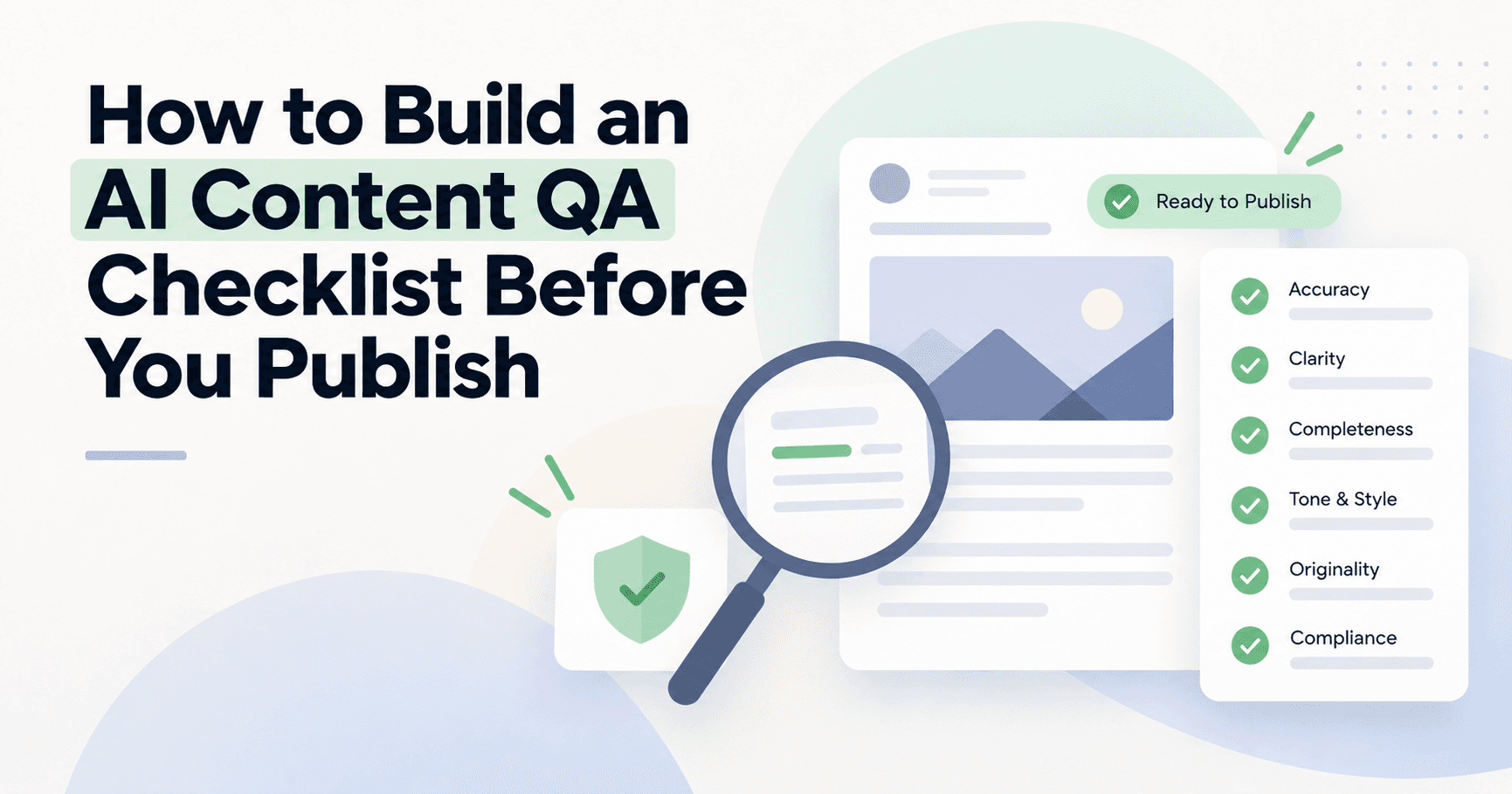
AI can make content production faster. It can also make mistakes faster.
That is why teams using AI for social media need a quality-control step that is short enough to use every time.
The goal is not to turn every post into a legal review. The goal is to catch the mistakes that matter before they become public.
1. Check factual accuracy
Start with the basics.
- Are product features described correctly?
- Are statistics sourced?
- Are dates current?
- Are customer claims verified?
- Does the post imply capabilities the product does not have?
AI is useful for drafting, but factual responsibility still belongs to the publisher.
2. Check brand voice
Ask whether the post sounds like your company or like generic generated copy.
Look for phrases your team repeatedly removes, exaggerated language, unnecessary filler, and a tone that does not match the topic.
A persistent AI Brand Voice profile can reduce these problems, but review is still useful for high-impact content.
3. Check the claim strength
Words such as “best,” “guaranteed,” “always,” “never,” and “proven” create a higher burden of proof.
If the evidence does not support the strength of the claim, soften it.
“Can reduce manual work” is different from “eliminates manual work.”
4. Check platform fit
A good LinkedIn post is not automatically a good X post.
Review the opening, length, formatting, CTA, and context for the destination platform.
If you are adapting one source across networks, use a content repurposing workflow instead of duplicating the same copy everywhere.
5. Check links and CTAs
Make sure every link works and every CTA matches what the post actually discussed.
Do not teach one problem and then send the reader to an unrelated pricing page.
If the post is about approvals, link to the social media approval workflow. If it is about automation, link to the relevant automation page.
6. Check for sensitive information
AI may summarize source material more freely than you intended.
Before publishing, look for:
- customer names
- private metrics
- internal roadmap details
- personal information
- confidential screenshots
- claims pulled from private notes
7. Check whether the post needs a human at all
Some content is low-risk and repetitive. Other content carries real judgment.
Major announcements, sensitive replies, customer stories, legal claims, or founder opinions often deserve closer review.
A good approval workflow makes that boundary explicit instead of treating every post exactly the same.
8. Check the queue, not just the post
A single post can be fine while the full week feels repetitive.
Review the batch for:
- the same opening repeated
- too many promotional posts
- the same product claim appearing several times
- identical CTAs
- too many posts aimed at the same audience stage
A 60-second AI content QA checklist
- Accurate?
- On-brand?
- Claims supported?
- Right platform format?
- Links working?
- No sensitive information?
- CTA relevant?
- No unnecessary repetition?
If any answer is uncertain, pause the post and fix it.
Quality control should get easier over time
If reviewers keep making the same correction, feed that information back into the system.
Update the voice rules. Improve the business context. Adjust the job instructions. Fix the source material.
The point is not to build a permanent editing department around AI. The point is to make the system produce fewer preventable mistakes.
Want AI to do more of the production while your team keeps control? See Bolta’s social media approval workflow.