Managing three social platforms feels like running three separate businesses.
You create a LinkedIn post. It performs well. Then you open Instagram and stare at a blank screen because what worked on LinkedIn sounds completely wrong there. So you start from scratch. Again.
Then Threads. Different audience. Different tone. Different format expectations.
By the time you have posted to all three platforms, you have spent six hours and you are not sure any of them actually said what you meant to say.
Why Platform-By-Platform Creation Breaks Down
The standard approach to multi-platform presence is sequential creation: write for LinkedIn, then Instagram, then Threads. Each platform gets its own dedicated content session.
This works until it does not.
The same account can publish similar content across platforms and see wildly different performance. What drives engagement on LinkedIn—professional framing with data and clear business outcomes—falls flat on Instagram where audiences expect personal storytelling with visual emphasis.
Meanwhile, Threads rewards rapid-fire, personality-driven takes that would seem too casual for LinkedIn.
When you create sequentially, you face a choice: copy-paste the same content everywhere and watch engagement drop, or spend hours rewriting the same core idea three different ways.
Most people choose a third option: they abandon two of the three platforms and put all their effort into whichever one feels least painful that week.
What a Content System Actually Means
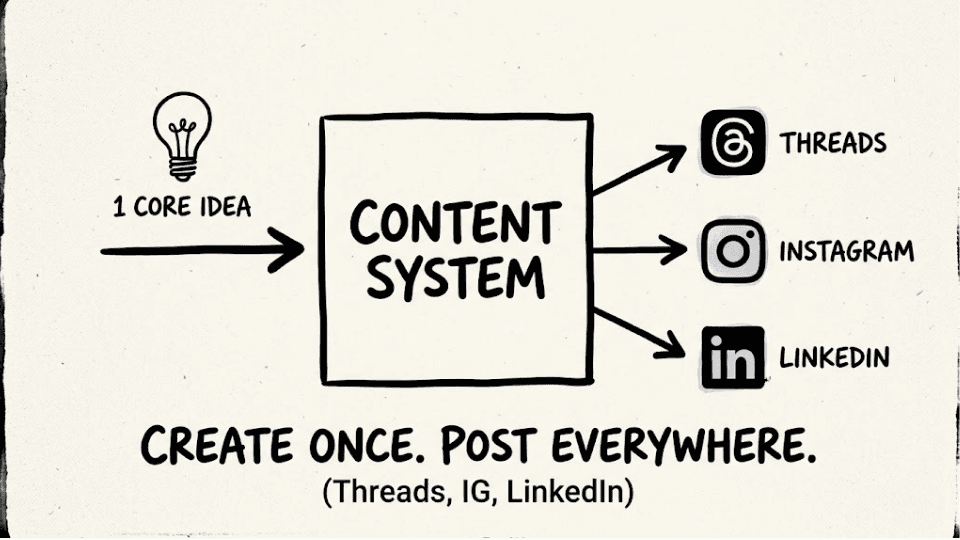
A system is not a calendar. A system is infrastructure that converts one input into multiple platform-appropriate outputs without requiring you to rethink everything from scratch each time.
The components of an effective multi-platform content system:
Core idea capture: A method for recording insights, frameworks, and observations as they occur rather than trying to generate content ideas on posting day.
Platform translation framework: Explicit rules for how the same core concept gets expressed differently on LinkedIn versus Instagram versus Threads.
Voice consistency mechanism: A way to ensure that platform-specific adaptations still sound like you rather than generic AI or corporate speak.
Distribution architecture: Infrastructure for scheduling and publishing adapted content across platforms without manual posting.
Feedback loops: Data about what performs on each platform that informs future content decisions.
When these components work together, you stop creating content three times and start creating it once with platform-specific expression.
Understanding Platform-Specific Requirements
Before building a system, you need clarity on what each platform actually rewards.
LinkedIn: Professional Context and Business Outcomes
LinkedIn has approximately 6.2 percent median engagement rate, placing it in the higher engagement tier.
LinkedIn audiences respond to content that connects ideas to business implications. The same insight that works everywhere needs professional framing here.
Format expectations: Longer posts work well. Three thousand characters gives you room to develop an argument with supporting evidence and clear takeaways.
Tone requirements: Conversational but credible. You can write in first person and share personal experience, but the frame should be why this matters for readers facing similar business challenges.
Visual norms: Text posts perform strongly. If you include images, they should reinforce the message rather than replace it. Carousels work for step-by-step frameworks or data visualization.
Instagram: Visual Storytelling and Personal Connection
Instagram shows approximately 5.46 percent median engagement rate.
Instagram is the platform where your personality needs to come through most clearly. The same business insight that worked on LinkedIn needs human framing here.
Format expectations: Shorter text blocks with strategic line breaks for mobile readability. Captions should feel like you are talking to a friend who asked a question.
Tone requirements: Personal and authentic. Share the experience behind the insight. Instagram audiences want to know what you learned, how you learned it, and why it matters to you personally.
Visual norms: Images are mandatory. The visual should capture attention first, then the caption provides depth. Carousels work for multi-part stories or before-and-after transformations.
Threads: Rapid Conversation and Cultural Commentary
Threads shows approximately 3.6 percent median engagement rate in the mid-tier.
Threads is on track to surpass X in daily users and is closely connected to Instagram, with follower recommendations and content based on your Instagram network.
Threads operates differently from both LinkedIn and Instagram. It favors velocity over polish and conversation over presentation.
Format expectations: Short bursts. Five hundred characters maximum per post but you can thread multiple posts together for longer thoughts.
Tone requirements: Casual and immediate. Threads rewards takes that feel like you just thought of them, even if you have been working on the idea for weeks.
Visual norms: Text-first. Images are optional and less important than on Instagram. The content itself needs to be interesting enough to stop scrolling.
The Translation Framework: Same Idea, Three Expressions
The key to multi-platform systems is understanding that you are not creating different content for each platform. You are expressing the same core concept in platform-native language.
Here is how translation works in practice:
Start with the core insight. What is the actual idea you want to communicate? Strip away all platform-specific framing and identify the kernel of value.
Identify the angle for each platform. LinkedIn wants to know why this matters for business. Instagram wants to know how you discovered this. Threads wants your hottest take on it.
Write in platform voice. LinkedIn gets professional structure with clear sections and business framing. Instagram gets personal storytelling with vulnerability. Threads gets punchy, conversation-starting statements.
Adapt format to platform. LinkedIn might be eight paragraphs with headers. Instagram might be a carousel with one point per slide. Threads might be a four-post thread where each post escalates the argument.
This is not copying. This is strategic adaptation that respects how different audiences consume information.
Where Voice Consistency Becomes the Bottleneck
The biggest challenge in multi-platform systems is not format adaptation. It is voice preservation.
You can manually rewrite a LinkedIn post for Instagram and Threads. It takes time but it is doable. The problem is that when you write three versions of the same idea back-to-back, your voice starts to drift.
The LinkedIn version sounds corporate. The Instagram version sounds like you are trying too hard. The Threads version sounds like someone else entirely.
Your audience can tell. They have internalized your communication patterns from hundreds of previous posts. Break those patterns and you lose the authenticity that built trust in the first place.
This is where most multi-platform strategies fail. Not from lack of effort but from inconsistency at scale.
How Content Operating Systems Solve Cross-Platform Voice
Traditional tools treat each platform as a separate workflow. You write a LinkedIn post in one tool, schedule Instagram in another, handle Threads separately.
The strongest social systems in 2026 are integrated systems where messaging, posting, community management, and analytics should inform one another instead of operating in separate silos.
The evolution is moving from disconnected tools to unified infrastructure where the system understands your voice and handles platform translation automatically.
This looks like: you input one core idea or piece of source content. The system generates platform-specific variations that sound like you wrote them because it has learned your communication patterns from your historical content. Each variation maintains your authentic voice while adapting to platform requirements.
Platforms like Bolta.ai treat multi-platform posting as a single workflow—connect your Threads, Instagram, and LinkedIn accounts, and the system generates posts optimized for each platform’s format and audience expectations while maintaining voice consistency across all three.
This is the difference between tools and operating systems. Tools help you post faster. Systems handle the entire adaptation process while preserving what makes your content yours.
Building Your Content Creation Routine
Once you have infrastructure that handles platform adaptation, the creation routine becomes simpler.
Batch idea capture throughout the week. When you notice something worth sharing—a client conversation, an industry observation, a personal realization—capture it immediately. Voice note, quick text file, whatever works. The goal is to collect raw material without judgment.
Designate creation time. Consistency happens because the time is protected—when it is time to create, you are not starting from scratch, you are pulling from your ideas and your plan. Block two hours once or twice per week for content creation.
Process ideas into platform variations. Take one captured idea and develop it into its full LinkedIn form first since that typically requires the most structure. Then adapt for Instagram and Threads using your translation framework.
Schedule distribution with spacing. Do not post the same idea to all three platforms on the same day. Space them across the week so followers who see you on multiple platforms do not experience obvious repetition.
Review performance and adapt. Track which concepts perform best on each platform. If your Instagram audience responds strongly to personal stories while your LinkedIn audience prefers frameworks, lean into those preferences in future content.
Common System Design Mistakes
Trying to post identical content everywhere. Content that performs with one audience can flop with another—match the post to each platform’s culture, not just its specs. The specs are easy. The culture is what matters.
Over-engineering the system before proving the model. Start with manual translation for two weeks to understand what adaptation actually requires. Then look for tools that automate those specific steps.
Ignoring platform-specific feedback. If something consistently underperforms on one platform, that is data. Either the content type does not fit that audience or your adaptation needs work.
Skipping voice preservation. If you sound like three different people across three platforms, you are not building an audience. You are fragmenting it.
Posting too frequently without substance. Threads rewards velocity but not at the expense of value. Quality still matters even on the fastest-moving platform.
The ROI of Unified Systems
Beyond five active platforms, the management overhead starts eating into the time savings. Three platforms—Threads, Instagram, and LinkedIn—hits the sweet spot where you reach different audience segments without overwhelming operational capacity.
The calculation is straightforward:
Creating separate content for three platforms: 6-8 hours per week.
Creating once with systematic adaptation: 2-3 hours per week.
The time savings compound because the system becomes repeatable. Every idea you capture can be expressed three ways without starting over each time.
For founders juggling product development with content creation, or small teams managing multiple client accounts, this efficiency gap is the difference between maintaining consistent presence and abandoning platforms entirely.
What Happens After the System is Running
Once you have infrastructure that handles platform adaptation reliably, your content strategy can evolve beyond execution logistics.
You stop thinking about how to rewrite the same post three times and start thinking about which ideas actually resonate with each audience segment.
You notice patterns in what performs. LinkedIn responds to frameworks and business implications. Instagram responds to personal stories and visual demonstrations. Threads responds to hot takes and rapid-fire commentary.
Those patterns inform what you create next. Not because you are chasing engagement but because you are learning what your audience actually needs from you on each platform.
The system handles execution. You handle strategy.
That is what makes multi-platform presence sustainable rather than something you attempt for a month and abandon when it becomes overwhelming.
Ready to see how this works in practice? Connect your Threads, Instagram, and LinkedIn accounts to Bolta.ai and watch it generate platform-native posts in your voice from a single input. Experience what unified content infrastructure actually feels like.